jual kayu murah menerima order bahan
Showing posts with label colon-cancer. Show all posts

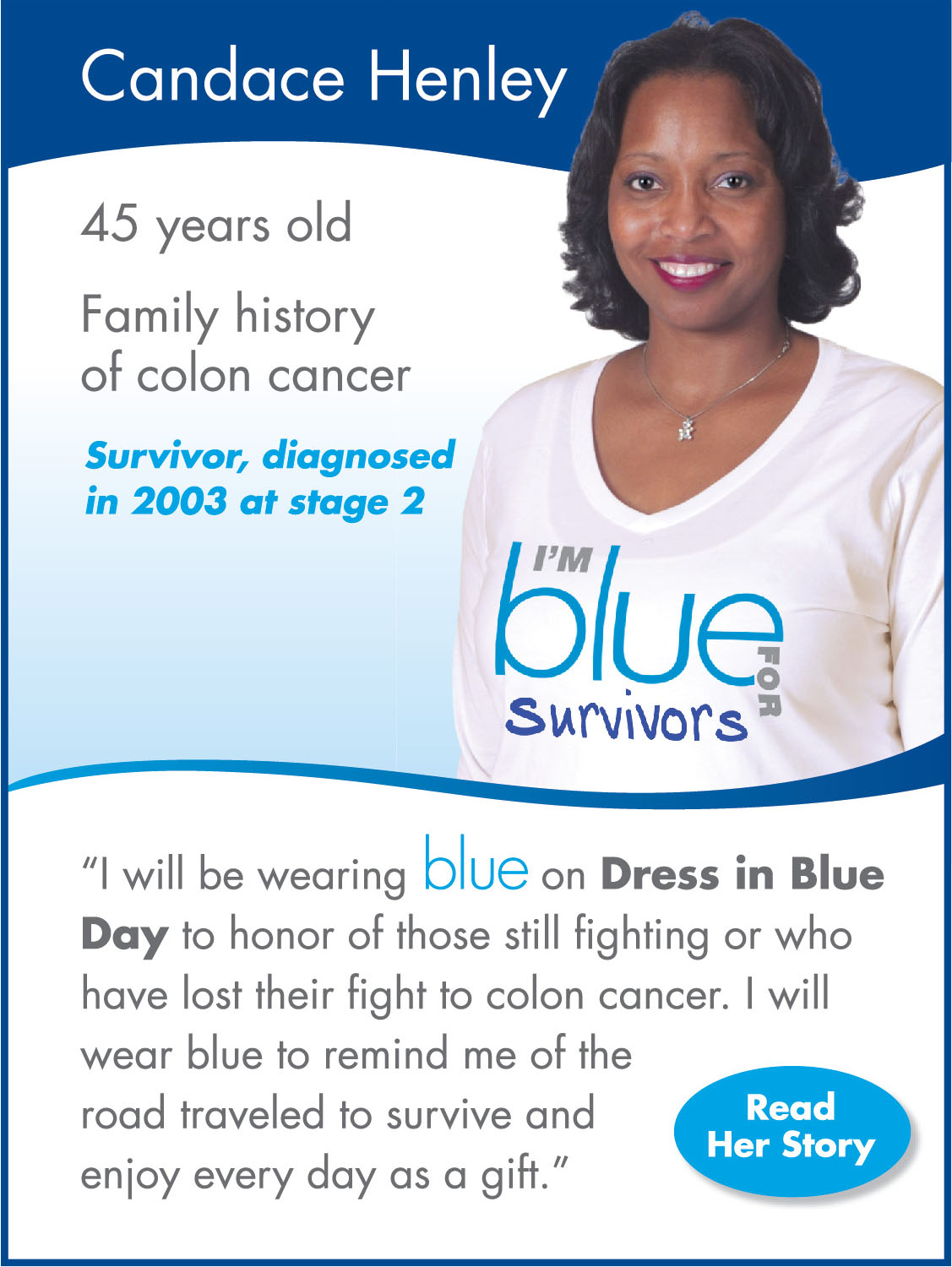
Dress In Blue Day for Colon Cancer Awareness
This blog post was written by the Colon Cancer Alliance. The Colon Cancer Alliance (CCA) is a community that provides hope and support to patients and their families, while saving lives through screening, access, awareness, advocacy and research.

Why should you wear blue? That’s the question the Colon Cancer Alliance (CCA) wants communities, businesses and individuals across the country (and even the world) to answer during its 5th annual Dress in Blue Day™ program on Friday, March 1st.

The CCA’s National Dress in Blue Day takes place every year on the first Friday in March as the official kickoff to National Colorectal Cancer Month. The program promotes awareness of colon cancer, encourages people to get their colon checked and ultimately, is working to put an end to this often preventable disease. On this special day, thousands of people throughout the United States will be showing their support by dressing in blue and talking to people about colon cancer and screening.
“Support for Dress in Blue Day has grown tremendously since we took this program to the national level in 2009,” said Andrew Spiegel, CEO of the CCA. “Each year, we are inspired to hear about more and more communities, individuals and businesses who are taking great strides to support Dress in Blue Day. Our goal is to have the entire country going blue so everyone knows that this a cancer they can do something about – whether it’s by wearing blue, holding an event or taking charge of their health by talking to their doctor.”

Facts About Colon Cancer

Currently, colon cancer affects 1 in 20 people.

More than 143,000 Americans will be diagnosed with the disease this year and 51,690 people will lose their battle with the disease.

But there is good news: Colon cancer is often beatable when detected and treated in its early stages or can be prevented altogether when polyps are removed before they develop into cancer. Dress in Blue Day works to make sure everyone knows this – encouraging local communities, businesses and the general public to support awareness of colon cancer by dressing in blue and hosting educational events.

For more information about Dress in Blue Day and to access these free resources, visit www.dressinblueday.com. And this March, help us spread colon cancer awareness – it could save someone’s life!

Register for the 2013 CANPrevent Colorectal Cancer Conference

The CANPrevent Colorectal Cancer Conference is free and open to the public. Come and learn the latest information on colorectal screening and managing the genetic risk for you and your family. Gain knowledge and take action by getting important information from our experts. Breakfast will be provided.

Date: Friday, March 22
Time: 7:30 am to 10:30 am
Location: Hilton Hotel, 4200 City Avenue, Bala Cynwyd, PA

Register for this free event here.

Register for the 2013 Focus on Colorectal Cancer Conference

TheFocus On Colorectal Cancer conference dedicated to colorectal cancer education. Come and learn the latest information on colorectal screening and managing the genetic risk for you and your family. Gain knowledge and take action by getting important information from our experts. Breakfast will be provided.

Date: Friday, March 22
Time: 7:30 am to 2 pm
Location: Hilton Hotel, 4200 City Avenue, Bala Cynwyd, PA

Register for this free event here.


How A Colonoscopy Can Save Your Life

February is Cancer Prevention Awareness Month. Here at the Abramson Cancer Center, we are committed to providing outstanding comprehensive cancer care and cancer information including ways to prevent cancer. Further, cancer researchers at Penn are at the forefront of learning new ways to prevent and detect cancer.

In this article, we discuss colonoscopy, and how a colonoscopy can actually prevent cancer. 
How-a-colonoscopy-can-save-your-life


Colorectal cancer (CRC) is one of the few cancers that can be prevented with screening. In the United States, it is recommended that everyone over the age of 50 be screened for CRC. If you have a family history of colon polyps, cancer at an early age or certain chronic medical conditions you may be encouraged to be screened starting at an earlier age.

Although the incidence of CRC and cancer-related deaths is decreasing, colon cancer screening remains underutilized. Consequently, CRC remains the third most common cancer worldwide and the second leading cause of cancer deaths.

One of the main barriers to CRC screening is the lack of awareness of the disease. CRC tends to not be discussed as openly as other conditions such as breast or lung cancer. Furthermore, the thought of undergoing a colonoscopy is not appealing to anyone. This is compounded by the fact that there is a general misperception about the study.

Colonoscopy can detect early tumors, and more importantly pre-cancerous growths of tissue called polyps. Polyps can be removed at the time of the procedure, thereby preventing you from ever developing cancer.

Know What to Expect at a Colonoscopy

Preparation for a colonoscopy involves using a prescription laxative the day before the procedure to clear the colon. Prior to the study, anesthetic medications providing “twilight” sedation are given through an IV. You are able to follow commands under twilight sedation, but remain comfortable if not asleep during the entire exam.

Once sedated, a long thin flexible tube with a light and a high-definition (HD) camera at the tip is inserted through the rectum and advanced to the end of your colon. The total length of the exam is typically 20 to 30 minutes.

For most patients, the hardest part of the exam is the preparation the day before the procedure. Many patients wake up from the sedation unaware that the test has already been performed. At Penn the preparation has been improved so the standard laxative solution is no longer a gallon of fluid, but is a more palatable combination of Miralax® dissolved in Gatorade®.

Roughly 80 percent of CRCs can be prevented with adequate screening and colonoscopy screening saves lives. I encourage everyone to begin the dialogue about CRC screening with their physicians. While no screening test is 100 percent perfect, colonoscopy remains the best method of screening for most individuals.

Are you 50 years old or older? Make an appointment at Penn Medicine for your routine colonoscopy by calling 1-800-789-PENN (7366).

Learn More About Colorectal Cancer Prevention

Register for a free conference about colon and rectal cancer prevention.

The CANPrevent Colorectal Cancer conference is FREE and open to the public. Come and learn the latest information on colorectal screening and managing the genetic risk for you and your family. Gain knowledge and take action by getting important information from our experts. Breakfast will be provided.

Date: Friday, March 22
Time: 7:30 am to 10:30 am
Location: Hilton Hotel, 4200 City Avenue, Bala Cynwyd, PA

Register for this free event here. 
 

Preventing Colon and Endometrial Cancer

March is colon and endometrial (uterine) cancer awareness month.

Did you know that approximately 90% of colorectal cancers are thought to be preventable?

Did you know that uterine cancer is the most common cancer of a woman’s reproductive system?

Don’t miss an upcoming program about colon and endometrial cancer on Tuesday, March 19 and Thursday, March 21 from 11:30 am to 1:30 pm in the Elm Garden Cafeteria at Pennsylvania Hospital.

Meet with and speak to health care professionals to learn more about colon and uterine cancer prevention.

Topics discussed will include:
  • Risk factors for colon and uterine cancer as well as signs and symptoms to look for
  • Colon Cancer Screening: facts and myths
  • Nutrition: foods to eat that reduce your risk for colon and uterine cancer
  • Genetics: how your family history affects your risk for colon and/or uterine cancer
  • Prevention: what steps you can take today to reduce your risk.

Register for the 2013 CANPrevent Colorectal Cancer Conference


The CANPrevent Colorectal Cancer Conference is free and open to the public. Come and learn the latest information on colorectal screening and managing the genetic risk for you and your family.
Gain knowledge and take action by getting important information from our experts. Breakfast will be provided.

Date: Friday, March 22
Time: 7:30 am to 10:30 am
Location: Hilton Hotel, 4200 City Avenue, Bala Cynwyd, PA

Register for this free conference about colorectal cancer prevention here. 

#ColonCancerACC Twitter Chat 3/20

Currently, colon cancer affects 1 in 20 people. One in 20.

Symptoms like persistent stomachaches and pains, rapid weight loss and bloody bowel movements may be symptoms of colon cancer.

And sometimes, like Michele learned, there are no symptoms at all.

“[A colonoscopy] was the only thing I hadn’t done, and I really didn’t think much of it,” remembers colon cancer survivor Michele. “I felt great; there wasn’t a reason to get one other than I was 50 and it was recommended I get one at 50.”

Two months before her 51st birthday, a colonoscopy revealed she had cancer.

“I probably had colon cancer for years before I went for a screening,” she says, “but without the screening, I may have found out too late.”

#ColonCancerACC Chat on 3/20

Colon cancer is often beatable when detected and treated in its early stages. Colon cancer van even be prevented altogether when polyps are removed before they develop into cancer.

Join Penn Medicine and the Abramson Cancer Center for a Twitter chat on Thursday, March 20 from Noon to 1 pm ET, #ColonCancerACC as we discuss colon cancer, prevention, and the factors that increase your risk.

Our panelists will include:


Save the Date

Mark your calendars, pack your lunch. We’ll be sharing important information that could save your life.

#ColonCancerACC
Thursday, March 20
Noon to 1 pm ET
On Twitter

Spread the Word

Helping someone learn the importance of regular colonoscopies can save a life. Share one of the images in this blog post, post a message on your Facebook timeline, or share a tweet.

Facebook post

Are you at risk?

Join @PennMedicine and nationally recognized experts from @PennCancer for a Twitter chat Thursday, 3/20 from Noon to 1 pm ET when we will discuss what you need to know about colon cancer.

Share with a friend/parent/family member/loved one – it’s info you don’t want to miss.

Tweet

Knowing risk and prevention can save your life. Join @PennMedicine @PennCancer for #ColonCancerACC chat 3/20 at Noon ET.

Live Online Video Colorectal Cancer Chat with Penn Medicine Experts 3/12

March is Colorectal Cancer Awareness Month. To learn more about screening, symptoms, treatments and the latest research, we’re teaming up with 6ABC for a live, streaming webchat at 6abc.com/pennmedicine

Colorectal Cancer - Did you know?

Colorectal cancer, cancer of the colon and rectum, is the second leading cause of cancer deaths in the United States.

You may be at a higher risk for colorectal cancer as you get older, but with education and screening, you can help reduce your risk.

Screening Can Save Lives

For those 50 years and older, getting a colorectal cancer screening can be life saving.

Symptoms like the appearance of polyps in the colon or rectum, persistent stomach aches and pains, rapid weight loss and bloody bowel movements may be key indicators. While these symptoms may be indicative of other ailments, colorectal cancer screenings can help you take the right next steps.

This March, Colorectal Cancer Awareness Month, be sure to ask the right questions, and get the facts.

Our Experts Answering Your Questions

Want to know more about:
  • Colorectal Cancer Screening?
  • Risk Evaluation?
  • Hereditary Risk?
  • Cutting Edge Treatment Options?
  • New Breakthrough Clinical Trials?
  • Survivorship?

James M. Metz, MD is the Vice Chair of the Clinical Division and Department of Radiation Oncology at the Hospital of the University of Pennsylvania, as well as the Associate Director for Clinical Services and Programs at the Abramson Cancer Center, and Najjia N. Mahmoud, MD is the Chief of the Division of Colon and Rectal Surgery as well as an Associate Professor of Colon and Rectal Surgery at Hospital of the University of Pennsylvania.

These Penn Medicine experts will be answering user-submitted questions in a live online chat.

To submit your questions and set up an email or phone reminder for the live webchat,
please visit 6abc.com/PennMedicine
.

What You Need to Know About Colon Cancer

March is colorectal cancer awareness month.

Colon and rectal cancer awareness is important because approximately 90 percent of colorectal cancers are thought to be preventable.

Other than skin cancers, colorectal cancer is the third most common cancer diagnosis among men and women in the United States.

Studies show that 1 in 20 Americans develop colorectal cancer during their lifetime.

Make an appointment for a colonoscopy at Penn

What is Colon Cancer?

Colon cancer is the third most common type of cancer in both men and women, and is the second leading cause of death from cancer in the United States. Colon cancer is cancer that forms in the lining tissues of the colon. Most colon tumors begin when normal tissue forms a polyp, or pre-cancerous growth projecting from the wall of the colon. As the polyp grows, a tumor forms. Because the tumor grows slowly, early detection is possible through screening and tests.

Colon cancer is often combined with rectal cancer and can be referred to as “colorectal cancer.”

Risk Factors for Colon Cancer

Some risk factors for colorectal cancer include:
  • Over the age of 50
  • Personal history of colorectal polyps or colorectal cancer
  • Personal history of inflammatory bowel disease
  • Family history of colorectal cancer
  • Inherited syndromes
    • FAP – familial adenomatous polyposis
    • HNPCC – hereditary non-polyposis colon cancer also known as Lynch syndrome
    • Juvenile polyposis
    • Peutz-Jegher
    • MYH gene
  • Racial and ethnic background – African Americans and Ashkenazi Jews
  • Lifestyle factors
    • Diet high in red meats and processed meats
    • Physical inactivity
    • Obesity
    • Smoking
    • Heavy alcohol use
    • Type 2 diabetes

Screening and Prevention of Colon Cancer

Regular screening exams such as colonoscopies can prevent colorectal cancer.  During colonoscopies, any abnormal cells that begin as polyps can be found and removed before they become cancerous. Screening can also result in early detection of colorectal cancer when it is highly curable.

Screening for colorectal cancer should begin at age 50 for those with no identified risk factor other than age. People with a family history or other risk factors should talk to their doctor about starting screening when they are younger.

If you have an early onset of colon polyps, colon cancer, or multiple family members with colon polyps or colon and uterine cancer, you should consider genetic counseling and testing. Genetic counselors can be contacted at Pennsylvania Hospital by calling 215-829-6528 or at the Hospital of the University of Pennsylvania by calling 215-349-8141.


Register for the 2013 Focus on Colorectal Cancer Conference


This is a free conference dedicated to colorectal cancer education. Come and learn the latest information on colorectal screening and managing the genetic risk for you and your family. Gain knowledge and take action by getting important information from our experts. Breakfast will be provided.


Register for this free event here. 

“If I can save one person from being where I was, that makes me happy.” - Michele

Michele on her 2-year "cancerversary."
At 50, Michele was feeling great. She’d done everything she was supposed to do to take care of her health.

Annual physical exam? Check.
Mammogram? Yup.
Echocardiogram? Done.
Skin check for moles and skin cancer? No problem.
Bone density scan? Solid.

But the one thing she’d put off was getting a colonoscopy.

“It was the only thing I hadn’t done, and I really didn’t think much of it,” remembers Michele. “I felt great; there wasn’t a reason to get one other than I was 50 and it was recommended I get one at 50.”

Two months before her 51st birthday, on Valentine’s Day, Michele had her colonoscopy in central New Jersey close to her home.

Her doctor found cancer. That colonoscopy saved her life.

“He told me he found lesions, and that I needed to see a specialist surgeon,” says Michele. “I left there dazed and confused.”

Michele met with Dr. Najjia Mahmoud, MD, Chief of the Division of Colon and Rectal Surgery in the Department of Surgery at Penn Medicine, one week later.

“Dr. Mahmoud had a calming effect,” says Michele. “She spoke to me in a way I could understand the process for my situation, she actually made it sound easy – and that put me at ease.”

It was stage 3 colon cancer, and after her surgery at Penn, Michele had 12 rounds of chemotherapy under the care of Ursina Teitelbaum, MD, medical oncologist at the Abramson Cancer Center.

“I was so impressed with Dr. Teitelbaum,” says Michele. “I walked into that first visit with two pages of questions, and she went through and answered each and every one.”

Michele got through those chemotherapy treatments, but it wasn’t an easy road.

“Chemotherapy was tough, but I got through it with the support of my friends and family, and the determination I had to get through it,” says Michele. “I walked every day – even if it was slow – because I knew that’s what I had to do.”

Today, Michele is cancer-free and is an advocate for colon cancer awareness. She’s participated in the Undy 5000 race, numerous awareness events, and supports multiple organizations through volunteer work. This year again, she had Governor Christie proclaim March, 2014, Colorectal Cancer Awareness Month in New Jersey.

“If I can save one person from being where I was, that makes me happy,” says Michele. “It’s estimated that 1 in 3 people are not up to date with their screenings, and that 1 in 20 will be diagnosed with colon cancer. Those numbers alone should alarm people to take action.”

Michele reminds us she had no symptoms of colon cancer – no pain, no blood in her stool, and her annual blood work was normal.

“I probably had colon cancer for years before I went for a screening,” she says, “but without the screening, I probably would have found out too late.”

Learn more about colorectal cancer treatment at the Abramson Cancer Center. 


We're sharing prevention information and facts about colorectal cancer on our Facebook page all month long. "Like" us to learn more!


Show Us Your Blue!


The Colon Cancer Alliance (CCA) is a community that provides hope and support to patients and their families, while saving lives through screening, access, awareness, advocacy and research.

Why should you wear blue? That’s the question the Colon Cancer Alliance (CCA) wants communities, businesses and individuals across the country (and even the world) to answer during its Dress in Blue Day™ program on Friday, March 7st.

The CCA’s National Dress in Blue Day takes place every year on the first Friday in March as the official kickoff to National Colorectal Cancer Month. The program promotes awareness of colon cancer, encourages people to get their colon checked and ultimately, is working to put an end to this often preventable disease. On this special day, thousands of people throughout the United States will be showing their support by dressing in blue and talking to people about colon cancer and screening.

Facts About Colon Cancer

Currently, colon cancer affects 1 in 20 people.

More than 143,000 Americans will be diagnosed with the disease this year and 51,690 people will lose their battle with the disease.

But there is good news: Colon cancer is often beatable when detected and treated in its early stages or can be prevented altogether when polyps are removed before they develop into cancer. Dress in Blue Day works to make sure everyone knows this – encouraging local communities, businesses and the general public to support awareness of colon cancer by dressing in blue and hosting educational events.

For more information about Dress in Blue Day and to access these free resources, visit www.dressinblueday.com. And this March, help us spread colon cancer awareness – it could save someone’s life!

Save the Date for the 2014 Focus On Colorectal Cancer Conference

Gain knowledge and take action by getting important information from our expert faculty. Receive hope and support by networking with others.

This year’s conference is intended to help those with colorectal cancer become active participants in their care through both the physical and emotional journey. Specifically, we will present sessions providing information tailored to the specific needs of those at risk, in treatment and survivors of colorectal cancer.

This event is FREE of charge. Breakfast, lunch and parking will be provided.

Date: Friday, June 20
Time: 7:30 am to 10:30 am
Location: Hilton Hotel, 4200 City Avenue, Bala Cynwyd, PA


Visit the Abramson Cancer Center on Facebook to stay up-to-date and learn when registration opens.
Don't forget to check back March 7th to see Penn Medicine friends and family wearing blue!

Surgery for Colorectal Cancer

Cary B. Aarons, MD, is an assistant professor of surgery in colon and rectal surgery. In this blog, he discusses surgical treatment of colorectal cancer.

Colorectal cancer is the third most common type of cancer diagnosed in the United States.

Fortunately, the overall prognosis for treating colorectal cancer is quite favorable if it is discovered early. In fact, up to 90 percent of patients whose colorectal cancer is diagnosed and treated in the early stages can be cured.

The management of colorectal cancer requires a team approach. From the time of diagnosis, comprehensive treatment demands a coordinated effort between the patient, family, gastroenterologist, oncologist, and surgeon. At Penn’s Abramson Cancer Center, every patient receives a multidisciplinary approach to their cancer care, meaning every member of the team involved in their care works together under one roof.

Experienced patient navigators also assist patients throughout the course of their treatment.

The treatment recommended primarily depends on the stage of the cancer, or the extent to which the cancer has spread.

Surgery offers the only potential for curing cancers localized to the colon and rectum. Invasive cancers localized to the colon typically require a partial colectomy, a procedure in which the part of the colon with the cancer is removed. This procedure can often be done with a laparoscopic approach. The surgeon makes smaller incisions in the abdomen through which specialized cameras and instruments can be inserted. This minimally invasive approach often results in less painful, quicker recovery and shorter hospital stays with similar results to conventional open surgery.

For rectal cancers, your team may recommend chemotherapy and radiation prior to surgery to decrease the possibility of local recurrence after surgery.

Advanced cases of colorectal cancer that have spread to other parts of the body require chemotherapy. In select cases, there may be a role for surgery.

Learn more about colorectal cancer treatment at the Abramson Cancer Center. 


We're sharing prevention information and facts about colorectal cancer on our Facebook page all month long. "Like" us to learn more!


March is colorectal cancer awareness month – learn more.

Navigating the Way to Colorectal Screenings at Penn

Colorectal cancer is the second most common cause of cancer deaths in the United States. Although studies prove that screening reduces colorectal cancer morbidity and mortality and is recommended for everyone over the age of 50, only 60 percent of Americans have been screened.

Penn Medicine’s West Philadelphia Gastrointestinal (GI) Health Outreach and Access Program has worked to to improve the colorectal cancer screening rates in the West Philadelphia community.

Founded in November 2011 with seed funding from an anonymous donor, the Abramson Cancer Center of the University of Pennsylvania established the program, which provides education about colorectal cancer screening and physical navigation through the screening process for people who live in the following zip codes:
  • 19104
  • 19131
  • 19139
  • 19143
  • 19151
Patient navigator, Alicia Lamanna, works with patients on a one-on-one basis and addresses barriers that might prevent them from getting a screening test. She also ensures patients understand the information by using language that is easy to comprehend.

Assisting patients every step of the way

The patient navigation program is committed to providing every patient the assistance and encouragement they need throughout the entire screening process.

The program provides the following:

  • Help with scheduling a colonoscopy
  • Education about the screening including literature, instructions for the screening preparation and motivational information
  • Encouragement and support
  • Reminder phone calls about the screening appointment
  • Instructions for the day of screening
  • Miralax-Dulcolax-Crystal Light prep free of charge
  • Transportation assistance with Septa tokens
  • Accompaniment to and from the screening exam
Finally, one week after the procedure, Alicia, communicates the physician's findings and recommendations both verbally and in writing to everyone who participates in the screening.

To qualify for the program patients must:
  1. Be between the ages of 50 and 75
  2. Live in one of the five participating West Philadelphia zip codes
  3. Have an order or prescription for a colonoscopy from your Penn primary care physician

Whether the reasons are financial, insurance or personal — such as being embarrassed or nervous — that keep someone from getting a colorectal screening, the outreach program provides the assistance needed to obtain this life-saving screening.

Patient Navigation Works

A study to determine the feasibility, acceptability and use of the program was recently completed.

Of the 125 patients who completed a screening colonoscopy through this program, 46 (37%) were found to have at least one adenomatous (precancerous) polyp and 3 patients were found to have cancer 1 primary colorectal cancer, 1 metastatic breast cancer, 1 currently unknown origin (unpublished data). These results show that this program has great potential to prevent colorectal cancer.

In addition, satisfaction with the program has been high, with 92% strongly agreeing with the statement: “Overall, I am satisfied with the navigation services I received from the navigator.”

In addition, 36% of the patients who completed the program stated they would have been, “highly unlikely to have completed the colonoscopy without the patient navigator.”

Get More Information

For more information about the program and preventing colorectal cancer, visit the 2012 CANPrevent Colorectal Cancer Conference from the Abramson Cancer Center, or call Alicia Lamanna at 215-439-8281.

As an American College of Surgeons Commission on Cancer accredited Center, Penn’s Abramson Cancer Center is pleased to share these results with the public.

Screening Colonoscopies Save Lives

Ursina Teitelbaum, MD, is a Penn Medicine assistant professor of medicine and medical oncologist specializing in gastrointestinal cancer, caring for older adults and symptomatic management of cancer patients.  In this first of two posts, Dr. Teitelbaum discusses the importance of colorectal cancer screening.

It is an exciting time to be a gastrointestinal oncologist, because of the array of advances in detection, prevention and treatment of colorectal cancers available today. 

In February, a study published in the New England Journal of Medicine reported the best evidence to date that colonoscopies, a colorectal cancer screening test, can actually prevent cancer deaths. Early detection has always been a goal of colonoscopy because colorectal cancers that are caught early are more amenable to surgical cure.  The premise of this study, however, was that the removal of precancerous polyps during colonoscopy might prevent the cancer from ever occurring. This prospect seemed to be realized by the finding of a greater than 50 percent decrease in death rate from colorectal cancer among patients who had a screening colonoscopy.

Decreasing the incidence of colon cancers in addition to detecting early colon cancers before they have an opportunity to spread is an incredible achievement in the existing screening programs.  Colorectal cancer is among the most common of all cancers diagnosed today, with more than 140,000 cases diagnosed annually in the United States. Roughly 100,000 cases are colon and 40,000 are rectal cancers.  These can be very lethal cancers, with more than 50,000 people dying yearly from colorectal cancer.

I work closely with gastroenterologists, surgical oncologists, radiation oncologists, and other medical specialties in the multidisciplinary care of colorectal cancer patients at Penn Medicine. All of us work relentlessly to bring the most aggressive and individualized care plans to every patient.  I also personally explain the rationale for each therapy and how to manage the side effects and symptoms of the cancer and the treatments for them.

Patients with early stage or locally advanced colon cancers often meet with me after their surgery to determine if they can benefit from postoperative (adjuvant) chemotherapy to enhance their chance for cure.  I like to call it an “insurance policy” for increasing the chances that the cancer won’t come back.  The chemotherapy regimens in this postoperative setting are quite tolerable and do not involve extreme nausea, fatigue, or hair loss.

But even when colon cancer has spread outside the original location and is considered stage IV cancer, there are many treatment modalities available including innovative clinical trials for colorectal cancer, biologic therapies and immunotherapies.  Penn uses advanced molecular profiling of every patient’s individual cancer to help personalize the therapy. 

In my next post, I will talk about how Penn Medicine takes a personalized approach to cancer treatment.

Learn more about the Abramson Cancer Center’s Gastrointestinal Cancers Program.